News & Stories
The stories of the Faculty of Arts and Sciences: the achievements and activities of our faculty, departments, and programs.
Search & Filter
Applied Filters:
-
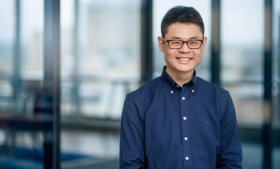
Yale data scientist Lu Lu is taking a physics-informed approach to artificial intelligence that has applications in an array of scientific and engineering disciplines.
-
Yihong Wu, whose work lies at the intersection of high-dimensional statistics, information theory, and computer science, joined the Yale faculty in 2016.

-
A new speaker series brings leading professionals in statistics and data science together with Yale students to talk about career development for women.

-
Do some anti-smoking policies help push people naturally predisposed to nicotine use into groups that actually reinforce the behavior? For Yale’s Ramina Sotoudeh, whose research integrates genetics and sociology, questions like this are all in a day’s work.

-
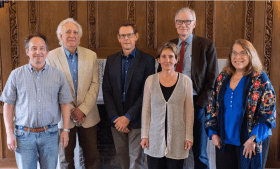
Yale College Dean Pericles Lewis recognized six recipients of the college’s annual teaching prizes during a reception on April 29.
-
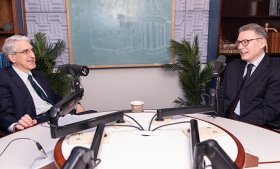
Professor Luciano Floridi, founding director of Yale’s Digital Ethics Center and professor in the practice in the Cognitive Science program, and President Peter Salovey discuss Yale’s new Digital Ethics Center to research the governance, ethical, legal, and social implications of digital innovation and technologies like artificial intelligence.
-
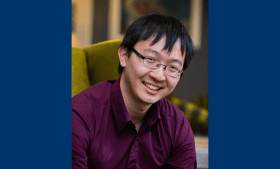
Zhou Fan has a way with numbers. With a few equations and computer simulations, he’s able to explore an incredible range of questions – from the propagation of information through neural networks, to the genetic underpinnings of complex traits — that are deeply connected to how we understand and process data.
-
With a focus on teaching and cross-disciplinary collaboration, Yale’s Department of Statistics and Data Science has expanded and evolved in recent years, more than doubling its faculty and moving to a central home in Kline Tower.

-
An acclaimed expert on the application of probability and statistics, Chang is also known at Yale for his leadership in statistical and quantitative education.
-
A member of Yale's faculty since 1992, Andrew Barron is an expert on statistical information theory, probability limit theorems, and neural networks.