Term ID

News & Stories

The stories of the Faculty of Arts and Sciences: the achievements and activities of our faculty, departments, and programs.

Search & Filter

Category

Applied Filters:

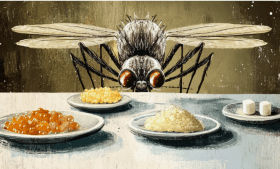
  1. Yale researchers led by John Carlson, Eugene Higgins Professor of Molecular, Cellular, and Developmental Biology, discovered a naturally occurring compound in garlic that halts mating and egg-laying in insects.

    Shimaa Ebrahim, associate research scientist, holds up a bottle containing garlic cloves. Photo credit: Anna Schroll
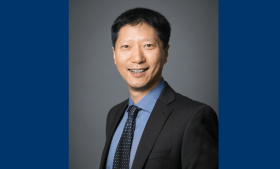
  2. Breaker, a field-leading biochemist and Yale leader, will serve as the FAS dean of science for a five-year term.

    Ronald Breaker
  3. Two faculty members received Yale College’s oldest teaching award during a ceremony last week, while the longest serving college dean was honored for her support of teaching and learning.

    From left: Joe Wolenski, Sarah Mahurin, and Roger Howe. Photos by Robert DeSanto
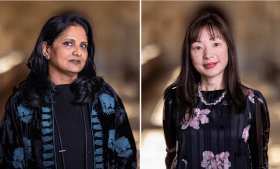
  4. Yale College Dean Pericles Lewis recognized four recipients of the college’s annual teaching prizes—who span all three divisions of the FAS—during a campus reception.

    Top row, Elleza Kelley and Julia Leonard. Bottom row, Jorge Méndez‑Seijas and Sigrid Nachtergaele. Photos courtesy of Yale Poorvu Center for Teaching and Learning.
  5. A new Yale study of flatworms, a species with the unique ability to “regenerate,” reveals that disruptions in the body’s internal “map” of cellular organization may play a part in age-related decline. The study was led by a PhD student, Andrew Verdesca, in the lab of Josien van Wolfswinkel, Associate Professor in Molecular, Cellular & Developmental Biology.

    Zoomed-in image of the head of a regenerated planarian, with the body of the animal shown in grey and the ovaries highlighted in green. Image credit: Andrew Verdesca.
  6. Susan Baserga, William H. Fleming Professor of Molecular Biophysics and Biochemistry, and F. Kenneth Nelson, Research Scientist and Senior Lecturer Emeritus in Molecular, Cellular and Developmental Biology, were elected to the latest class of fellows for the American Association for the Advancement of Science.

    Headshots of five new Yale affiliates elected to the 2026 class of fellows for the American Association for the Advancement of Science.
  7. Ronald Breaker, Sterling Professor of Molecular, Cellular & Developmental Biology and Professor of Molecular Biophysics & Biochemistry, reflects on his career and his discovery of riboswitches—ancient RNA devices that sense molecules and control genes.

    Ronald Breaker
  8. David Breslow, Associate Professor in Molecular, Cellular and Developmental Biology, and his lab are using a genetic screening technique they developed that reveals an unprecedented view into the relationship between developing cells and disease.

    Illustration of the microscopy screening strategy. The basic steps include: 1) acquiring a microscopy image of cells with labeled cilia (green) and centrioles (magenta); 2) using AI-based image analysis to identify the cilia and centrioles within the image; 3) defining regions to target so that ciliated cells can be selectively marked by photoactivation; and 4) carrying out the photoactivation, which marks ciliated cells red and thus allows these cells to be isolated for further analysis.
  9. In a Q&A, trailblazing chemist and serial entrepreneur Craig Crews — whose third venture was recently acquired for more than $3 billion — discusses the transformative science emerging from Yale, and how bringing innovative ideas to market is good for the university and New Haven.

    Craig Crews. Photo credit: Marissa Fiorucci
  10. A company utilizing an approach to capturing disease-causing proteins developed by the lab of Craig Crews, John C. Malone Professor of Molecular, Cellular, and Developmental Biology and Professor of Chemistry, was recently acquired by Johnson & Johnson.

    Craig Crews