News & Stories
The stories of the Faculty of Arts and Sciences: the achievements and activities of our faculty, departments, and programs.
Search & Filter
Applied Filters:
-
In a Q&A, Charles Baltay — Eugene Higgins Professor Emeritus of Physics — discusses his work on a groundbreaking project that is creating a 3D map of the universe — and could answer longstanding questions about dark energy.

-
Yale's Pieter van Dokkum, Sol Goldman Family Professor of Astronomy and Professor of Physics, led the discovery team that found the black hole, which is rocketing through its home galaxy at 2.2 million miles per hour.
-
Yale researchers, including FAS faculty, study a mass extinction from the distant past, uncover hidden brain networks, and share expertise at an international meeting on enhanced weathering.

-
Pieter van Dokkum, Sol Goldman Family Professor of Astronomy and Professor of Physics, led the analysis and coordinated the follow up program.

-
Basu, William K. Lanman Jr. Professor of Astronomy, speaks with a panel of guests about the role of our sun in human history and what the future holds for our nearest star.
-
TIME Magazine highlights a recent discovery by Pieter van Dokkum, Sol Goldman Family Professor of Astronomy and Professor of Physics, of a pair of spiral galaxies that collided in space.
-
A Yale-led astronomy team may have discovered the first direct evidence of a supermassive black hole just after it formed — in a galaxy they’re calling “Infinity.”

-
Earth.com interviews Malena Rice, Assistant Professor of Astronomy, about her recent study which maps binary stars.

-
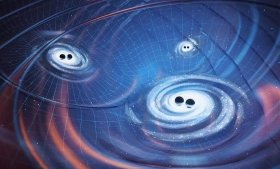
In a Q&A, astrophysicist Chiara Mingarelli explains how black hole mergers and quasars are helping lay the groundwork for detecting a network of gravitational waves.
-
Every Fourth of July, Carnegie Corporation of New York celebrates remarkable Americans — all naturalized citizens — who have enriched and strengthened our democracy through their actions and contributions.
